

Rice Polisher
Why Choose Us?
Advanced equipment
The company mainly produces rice milling machinery, and its products cover the entire process of rice initial processing from rice cleaning, stone removal, hulling, separation to rice whitening, polishing, and color selection. There are a total of 7 series and more than 130 varieties. The company has a comprehensive product development system and modern production capacity, as well as industry-leading professional process equipment and product research and development centers.
Rich experience
Yutai Jinyuan Machinery Co., Ltd. is a professional manufacturer of grain processing equipment with a 30-year history. The company has a registered capital of 10 million yuan and total assets of over 30 million yuan.
Professional team
Our company has a professional design team with many years of market experience, which has participated in the design, installation, commissioning, and service of multiple complete projects. The company has a professional installation team of more than 20 people, who can organize or allocate installation personnel at any time to improve customer progress and ensure project schedule.
High quality
For each complete set of projects, especially large-scale engineering projects, a project team will be established to design, order, purchase, produce, distribute, transport, deliver, install, debug, and supervise quality, coordinate work progress, and project team members are both independent and cooperative, enabling the entire project to proceed smoothly.
What Is a Rice Polisher
A rice polisher is a unique facility where raw paddy is processed into rice. Rice mill machines are used in the rice milling process to remove any impurities in rice with ease. There are many types of rice mills available in the market today, which can make it hard to identify the best option. Nonetheless, it is important to buy the right machine as that will determine the quality of the final product.
-
![Complete Set Of Machinery And Equipment For Processing 80 Tons Of Rice Per Day]() Complete Set Of Machinery And Equipment For Processing 80...The complete set of rice processing machinery with a daily output of 80 tons is composed of multiple key process equipment, including bucket lifting, screening and impurity removal, specific...read more
Complete Set Of Machinery And Equipment For Processing 80...The complete set of rice processing machinery with a daily output of 80 tons is composed of multiple key process equipment, including bucket lifting, screening and impurity removal, specific...read more -
![Small Combination Rice Mill]() Small Combination Rice MillThis small combination rice mill is a compact all-in-one paddy processing machine, perfect for small-scale rice production needs. It finishes paddy hulling, milling, polishing and impurity...read more
Small Combination Rice MillThis small combination rice mill is a compact all-in-one paddy processing machine, perfect for small-scale rice production needs. It finishes paddy hulling, milling, polishing and impurity...read more -
![Complete Rice Milling Equipment]() Complete Rice Milling EquipmentYour small rice mill is stuck in a loop: slow processing, broken grains piling up, and labor costs eating into profits. You’re tired of patching together old machines and watching good rice go to...read more
Complete Rice Milling EquipmentYour small rice mill is stuck in a loop: slow processing, broken grains piling up, and labor costs eating into profits. You’re tired of patching together old machines and watching good rice go to...read more -
![Large Combined Rice Mill]() Large Combined Rice MillThe rice production equipment mainly includes pretreatment equipment, processing equipment, and storage equipment. Pre processing equipment includes cleaning equipment, screening equipment, and...read more
Large Combined Rice MillThe rice production equipment mainly includes pretreatment equipment, processing equipment, and storage equipment. Pre processing equipment includes cleaning equipment, screening equipment, and...read more -
![Industrial Rice Milling Machine]() Industrial Rice Milling MachineThe above is the fully automated operation process of a large rice mill, which completes the cleaning, threshing, crushing, screening, and grinding of rice through automation. While automating, it...read more
Industrial Rice Milling MachineThe above is the fully automated operation process of a large rice mill, which completes the cleaning, threshing, crushing, screening, and grinding of rice through automation. While automating, it...read more -
![Combined Rice Mill]() Combined Rice MillThe complete set of fully automatic rice milling equipment of Yutai Jinyuan Machinery Co., Ltd. realizes functions such as rice cleaning, hulling, and milling, with high automation, integrated...read more
Combined Rice MillThe complete set of fully automatic rice milling equipment of Yutai Jinyuan Machinery Co., Ltd. realizes functions such as rice cleaning, hulling, and milling, with high automation, integrated...read more -
![Mini Rice Milling Machine]() Mini Rice Milling MachineThe rice processing equipment of Yutai Jinyuan Grain Machinery includes the rice cleaning section, hulling separation section, rice milling and finished product sorting section. Each section is...read more
Mini Rice Milling MachineThe rice processing equipment of Yutai Jinyuan Grain Machinery includes the rice cleaning section, hulling separation section, rice milling and finished product sorting section. Each section is...read more -
![Electric Rice Mill]() Electric Rice MillRice production equipment is the foundation and core of the entire production line. Different equipment has different purposes and functions, and can achieve automation and intelligence in rice...read more
Electric Rice MillRice production equipment is the foundation and core of the entire production line. Different equipment has different purposes and functions, and can achieve automation and intelligence in rice...read more -
![Rice Sheller Machine]() Rice Sheller MachineThis article introduces the machine composition of the rice hulling production line, which is a rice processing equipment of Jinyuan Grain Machinery. It includes a combination rice mill, a...read more
Rice Sheller MachineThis article introduces the machine composition of the rice hulling production line, which is a rice processing equipment of Jinyuan Grain Machinery. It includes a combination rice mill, a...read more -
![4 in 1 Rice Milling Machine]() 4 in 1 Rice Milling MachineRice processing equipment is a finished product made from rice through processes such as cleaning, hulling, and milling. The emergence of rice processing equipment has increased the added value of...read more
4 in 1 Rice Milling MachineRice processing equipment is a finished product made from rice through processes such as cleaning, hulling, and milling. The emergence of rice processing equipment has increased the added value of...read more -
![Combined Rice Milling Machine]() Combined Rice Milling MachineIf you’re running a small or medium rice mill in Vietnam, Malaysia, or the Philippines, you’ve probably had enough of using multiple machines to get from paddy to clean white rice. Think about...read more
Combined Rice Milling MachineIf you’re running a small or medium rice mill in Vietnam, Malaysia, or the Philippines, you’ve probably had enough of using multiple machines to get from paddy to clean white rice. Think about...read more -
![Rice Milling Machine For Home]() Rice Milling Machine For HomeYutai Jinyuan Machinery Co., Ltd. is located in Jining, Shandong. From research and development design, raw material selection, production welding, to national sales, our company's intelligent...read more
Rice Milling Machine For HomeYutai Jinyuan Machinery Co., Ltd. is located in Jining, Shandong. From research and development design, raw material selection, production welding, to national sales, our company's intelligent...read more


Rice Polisher Operations
A rice polisher is an agricultural machine used to automate the process of removing the chaff (the outer husks) of grains of rice. Throughout history, there have been numerous techniques used to hull rice. Traditionally, it would be pounded using some form of mortar and pestle. An early simple machine to do this is a rice pounder. Later even more efficient machinery was developed to hull and polish rice.
The huller uses steel rollers to remove the husk. Other types of huller include the disk or cono huller which uses an abrasive rotating disk to first remove the husk before passing the grain to conical rollers which polish it to make white rice, this is done repeatedly since other sides of circular side of rice are not husked. Rubber rollers may be used to reduce the amount of breakage of the grains, so increasing the yield of the best quality head rice, but the rubber rollers tend to require frequent replacement.
There are different types of rice polisher available but the type of rice end product determines the type of rice polisher farmers should get between an under-runner disc, a rubber-roll or an engelberg rice mill. The choice of rice polisher to get also often depends on the ability to share existing knowledge and experience, and the knowledge that maintenance support can be obtained quickly if trouble arises.
Rice farmers have in general been the most likely people to buy rice polishers. They have the raw, unmilled rice, can see the added value that comes from milling the grain and can easily install the equipment on their farms. They can set up a small building and may have access to labour or a family member to operate the rice polisher. They may transfer some of their existing tasks in order to concentrate on the milling, which requires skill in operation and management. Most farmers would wish to keep an item representing such considerable investment under their personal control.
Facilities for parboiling, drying, cleaning or polishing the milled rice can be linked to the enterprise and will add value to the finished product. Rice polishers are abrasive machines that use talc or some other very fine dust to buff the outer surface of rice kernels.
Rice Milling Operation Cost
There are three different types of cost drivers in the rice mill operation.
1. Material cost
This is determined with the help of the quantity of the stock and the unit price of it. This determines the workpiece, size, stock size, method of cutting the stock and the production quantity of it.
2. Production cost
This is a result of the total production time and the hourly rate. This includes the setup time, load time, cut time, idle time and the tool replacement time. The entire production cost is dependent on the skill of the operator.
3. Tooling cost
This is determined by the total number of cutting tools required and the unit price for each tool. There are a number of unique tools that are required for the various operations to be performed. With the daily uses of the tools, the lifetime of a tool is reduced.
Rice milling is one of the important processes & modern rice mill machines are required for the proper dimension of the rice that is prepared.

How to Maintain the Rice Polisher
1. Before running the rice polisher we must try running. In the process of rice polisher operation, a fixed staff should be responsible for guarding, operate staff must have a certain skill level. Staff must receive necessary technical training for rice polisher maintenance and installation, after understand the principle of function to better master the control procedures.
2. Rice polisher should be tested after period of running time, roller, grinding ring, scraper knife and wearing part should be replaced. Connecting bolt and nut of the roller should be examined before and after use, to ensure there is no loose phenomenon or lubricating grease lack.
3. We must clean the rice polisher when it finishes work, and check all parts consumption, timely replacement or repair worn parts.
Rice Polisher: Modern Rice Milling Process Steps
Rice milling in modern age is the combination of several commercial milling operations that produce better quality white rice from rough rice (rice paddy).
● Modern rice milling processes
Milled rice is being produced, in rice mills, after removing bran, husk and germ. Rice produced after modern rice milling process has different flavor, appearance ( whiten) and extended life.
Rice milling process is all about producing edible milled rice after separating the husk (20%), the bran layers (11% ) & clean rice (69%) aka starchy endosperm.
In an ideal milling process this will result in 20% husk, 8−12% bran depending on the milling degree and 68−72% milled rice or white rice depending on the variety.
Let's discuss rice mill functioning and steps in rice milling processes from pre-cleaning to packaging for sale.
● Rice pre-cleaning process
Paddy rice cleaning process also called rice paddy cleaning process. It is first step in rice milling systems after rice paddy comes for milling process in rice mill from rice farms.
Paddy always comes up having a lot of external material including weed, soil, seeds, etc. And these external things need to be removed before taking it to the hulling processes, so that the efficiency of the huller, as well as milling, would not get affected.
If they are not removed properly then the efficiency of the rice mill machinery can be reduced. The capacity of the paddy pre-cleaner is actually, 1.5 times the milling capacity. It makes rice milling an ideal in this modern age.
● Removing the husk (dehusking or dehulling)
Brown rice is actually produced by removing the husk from rough paddy rice. The husk is actually removed using friction so that paddy grains can easily pass in between two abrasive surfaces that move following different speeds.
It makes easy to let husk removed following suction and transported to a storage dump outside the mill. It means you would not have to confront a lot of hassle anymore.
● Paddy separation
Paddy separator is good at unhusked paddy rice from brown rice making easier to go ahead with the next procedure in modern rice milling systems.
Talking about the amount of paddy actually depends on different thing including the efficiency of the husker and it should not be more than 10%. Paddy separators work in a great way making the entire procedure easier and smooth.
Paddy rice is fed to the paddy separator in rice mills. Paddy rice is separated from brown rice and the separated paddy rice will then be removed.It also called "rice residue".
● Whitening or polishing
Do you know that how whitening or polishing rich are made? Here, we are going to talk about rice whitening process in modern rice mill.
Actually, white rice is produced removing the bran layer and then germ from the paddy. Now, you might be thinking that how does bran layer is removed. To put in simple words, the bran layer is removed from the kernel going with the different policies such as abrasive or friction polishers. The amount of bran removed is normally between 8 and 10% of the total paddy weight.
● Separation of white rice
And the next on the list is all about separation of white rice. Once rice polishing is done, white rice is separated into head rice, small, broken and large rice.
Head rice is generally categorized as kernels having ration of 75-80o or more of a whole kernel. In order to have a higher degree of precision for grading and separation a length or indent grader is used.
● Rice mixing
Talking about a good modern age rice mill, it generally produced 50−60% head rice (whole kernels), 5−10% large broken, 10−15% small broken kernels.
Moreover, it also depends on country standards as well as what is all about the rice grades in the market as it will contain from 5−25% broken kernels. If rice mixing is get done in a sophisticated manner then a volumetric mixer is necessary.
● Mist polishing
It is all about mixing a fine mist of water having dust retained on the whitened rice in order to improve the luster of rice. The motto is not compromising with the quality of rice. A friction type of whitening machine plays a major role to deliver a fine mist of water during the final whitening process ideal for "final" polishing before the sale.
● Rice weighing
Now, it is time to know about rice weighing. To put in simple words, rice is normally sold in 50 kg sacks and it should be weight accurately and labeled. These days, most rice mills are preferring to go with the advanced manual mechanical weighing system, so that they can have accurate results. This fast electronic system is considered ideal to go ahead.
To make more profit, it is needed to make sure that you are going to have advanced machinery at your work to gain amazing results in rice milling operations.

1. Fraction-type rice polisher
The fraction-type rice polisher relies on the strong friction of an iron roller to process brown rice into white. It is also commonly referred to as a pressure-type rice polisher. The machine processes rice by the action of advancing and flipping off the iron roller. This movement causes strong collision, squeezing, and friction between rice particles. Then in the whiting chamber, there are components that separate the endosperm and cotyledon of brown rice to attain white rice.
2. Grind rice polisher
The grind rice polisher removes the bran layers by grinding and cutting rice grains using the emery roller at high speeds ranging from 10 to 16 grains per second. This results in lower rice breakage and increases the output of white rice. There are two types of rice polishers: Vertical and horizontal types.
Market Share for Rice Mills
Our Factory
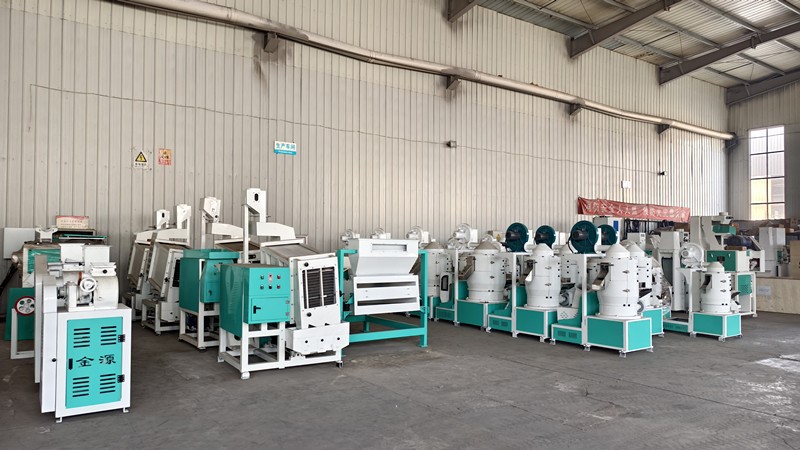
Yutai Jinyuan Machinery Co., Ltd. is a professional manufacturer of grain processing equipment with a 30-year history. The company has a registered capital of 10 million yuan and total assets of over 30 million yuan. It covers an area of 50000 square meters and employs more than 50 people. The company mainly produces rice milling machinery, and its products cover the entire process of rice initial processing from rice cleaning, stone removal, hulling, separation to rice whitening, polishing, and color selection. There are a total of 7 series and more than 130 varieties. The company has a comprehensive product development system and modern production capacity, as well as industry-leading professional process equipment and product research and development centers. The company has participated in the construction of large-scale complete rice milling projects both domestically and internationally, ranking among the top in comprehensive market share.


Production Equipment



FAQ
As one of the leading rice polisher manufacturers and suppliers in China, we warmly welcome you to buy durable rice polisher made in China here and get quotation from our factory. All customized machines are with high quality and competitive price.