
Paddy Separator
Why Choose Us?
Advanced equipment
The company mainly produces rice milling machinery, and its products cover the entire process of rice initial processing from rice cleaning, stone removal, hulling, separation to rice whitening, polishing, and color selection. There are a total of 7 series and more than 130 varieties. The company has a comprehensive product development system and modern production capacity, as well as industry-leading professional process equipment and product research and development centers.
Rich experience
Yutai Jinyuan Machinery Co., Ltd. is a professional manufacturer of grain processing equipment with a 30-year history. The company has a registered capital of 10 million yuan and total assets of over 30 million yuan.
Professional team
Our company has a professional design team with many years of market experience, which has participated in the design, installation, commissioning, and service of multiple complete projects. The company has a professional installation team of more than 20 people, who can organize or allocate installation personnel at any time to improve customer progress and ensure project schedule.
High quality
For each complete set of projects, especially large-scale engineering projects, a project team will be established to design, order, purchase, produce, distribute, transport, deliver, install, debug, and supervise quality, coordinate work progress, and project team members are both independent and cooperative, enabling the entire project to proceed smoothly.
What Is a Paddy Separator?
A paddy separator utilizes differences in the physical properties of rice and brown rice, such as density, surface friction, and heat coefficient, to perform its function. It operates with a rough working surface that tilts in both directions and vibrates back and forth. This design allows for automatic grading of grain mixtures based on their roughness.
In the separation process, rice grains "float" or "sink" based on their properties. Brown rice moves upwards and is discharged from the inclined upper part of the working surface due to the blocking action of protrusions on the rough surface. Meanwhile, rice moves downwards under its own gravity and feed thrust and is discharged from the lower outlet. This process effectively separates the rice from the husks.
-
![20 Ton Double Paddy Separator]() 20 Ton Double Paddy SeparatorThe 20 ton double paddy separator is a professional grain processing equipment designed for large-scale rice mills, specializing in separating brown rice from unhusked paddy with exceptional...read more
20 Ton Double Paddy SeparatorThe 20 ton double paddy separator is a professional grain processing equipment designed for large-scale rice mills, specializing in separating brown rice from unhusked paddy with exceptional...read more -
![100x10 Paddy Separator]() 100x10 Paddy SeparatorThe 100x10 Paddy Separator is a core gravity separation machine for rice milling lines, specially designed to separate paddy from brown rice with high precision. It works based on the different...read more
100x10 Paddy SeparatorThe 100x10 Paddy Separator is a core gravity separation machine for rice milling lines, specially designed to separate paddy from brown rice with high precision. It works based on the different...read more


Paddy Separator Working Principle
Paddy separator machine is used to separate the brown rice from the paddy that is not be husked, it workds according to the difference of specific gravity, granularity and friction coefficient between paddy and brown rice, through the special separating tray to screen the mixture continuously, making it in stratification state.
Due to the function of separation, big-density and small-size brown rice towards to the upper of the separating tray, small specific gravity and large-size paddy towards to the lower part of the separating tray, then separating pure brown rice, mixture and pure paddy.
The Basic Methods of Paddy Separators
Currently, the commonly used paddy separator machines mainly include the screening method and the density separation method.
Screening Method of Rice Separator Machine
The screening method in a rice separator mill utilizes the difference in particle size between rice and brown rice, along with its automatic grading characteristics. The machine is equipped with appropriate sieve holes and employs a specific sieve surface movement to separate the grains. A commonly used piece of equipment is the rotary screen for rice separation.
In this method, the paddy grains and rice are separated using a rotary screen that takes advantage of physical differences such as grain size, density, and surface friction coefficient. The screen performs a plane rotary motion, causing rice with larger particle size, lower density, and rough surface to float on the upper layer of the material. In contrast, brown rice, with smaller particle size, higher density, and smoother surface, sinks to the bottom layer. Brown rice comes into contact with the sieve surface and passes through the sieve holes, becoming undersize. The rice is blocked by the brown rice layer and does not easily pass through the sieve holes, becoming oversize. This process achieves effective grain separation.
Density Separation Method of Rice Mill Separator
The density separation method involves separating grains on a rough working surface with reciprocating vibration, based on differences in physical properties such as density and surface friction coefficient between rice and brown rice. This method relies on the automatic classification characteristics of the grains. Commonly used separation equipment includes the rice paddy separator machine or the rice mill paddy separator.
Exploring the Types of Paddy Separators
The choice of paddy separator type depends on the specific requirements of the rice milling operation, including capacity, efficiency, and processing conditions.
● Gravity paddy separator: This relies on the fundamental principle of gravity, leveraging weight changes to separate the rice.
● Inclined tray paddy separator: This type uses inclined trays to create a gentle slope, allowing the movement of brown rice while controlling the paddy – just like a slide
● Vibrating tray paddy separator: This separator uses vibrating trays. The vibration facilitates the separation of paddy and brown rice based on their density and specific gravity, ensuring efficient sorting
● Centrifugal paddy separator: This type employs a spinning drum, creating a force that pushes the paddy outward, separating it from brown rice.

The Modern Milling Process: Paddy Separator
Pre-cleaning
When paddy comes into the mill, it contains foreign materials such as straw, weed seeds, soil, and other inert materials. If these are not removed before hulling, the efficiency of the huller and milling recovery will be reduced. The capacity of the paddy pre-cleaner is normally 1.5 times the milling capacity.
Removing the husk (dehusking or dehulling)
Brown rice is produced by removing the husk from rough paddy rice. The husk is removed by friction as the paddy grains pass between two abrasive surfaces that move at different speeds. After dehusking, the husk is removed by suction and transported to a storage dump outside the mill. Husk accounts for 20% of the paddy weight and an efficient husker should remove 90% of the husk in a single pass.
Paddy separation
The paddy separator separates unhusked paddy rice from brown rice. The amount of paddy present depends on the efficiency of the husker and should not be more than 10%. Paddy separators work by making use of the differences in specific gravity, buoyancy, and size between paddy and brown rice.
Whitening or polishing
White rice is produced by removing the bran layer and the germ from the paddy. The bran layer is removed from the kernel through either abrasive or friction polishers. The amount of bran removed is normally between 8 and 10% of the total paddy weight. To reduce the number of broken grains during the whitening process, rice is normally passed through two to four whitening machines connected in series.
Separation of white rice
After polishing, white rice is separated into head rice, large and small broken rice, and "brewers" by an oscillating screen sifter. Head rice is normally classified as kernels that are 75−80% or more of a whole kernel. To attain a higher degree of precision for grading and separation a length or indent grader is used.
Rice mixing
A good rice mill will produce 50−60% head rice (whole kernels), 5−10% large broken and 10−15% small broken kernels. Depending on country standards, rice grades in the market will contain from 5−25% broken kernels. If rice mixing is to be done properly, then a volumetric mixer is necessary.
Mist polishing
Mixing a fine mist of water with the dust retained on the whitened rice improves the luster of rice (polishes) without significantly reducing milling yield. A friction type of whitening machine, which delivers a fine mist of water during the final whitening process, is used for "final" polishing before sale.
Paddy Separator Can Separate the Chaff and Rice
A paddy separator is specialized equipment used in the rice milling process. It is primarily employed to remove bran from white rice and excess water, thereby reducing the rice temperature. This ensures that the rice can be polished at a lower temperature in the polisher, improving the polishing effect. It is beneficial for the storage and transport of rice, extending its storage time. The paddy separator is a new type of rice mill, mainly used for processing Japonica rice and is widely utilized in urban, rural, and small to medium-sized rice processing operations. It is the preferred choice for current paddy processing.
The paddy separator is equipped with an air spraying apparatus, which effectively separates the chaff from the rice. A key feature of this rice mill machine is its ability to process rice into standard white rice in one pass, resulting in bright and clean rice with low temperature and minimal chaff powder content.
The paddy separator features a simple process, compact structure, small footprint, low power consumption, low noise, and ease of operation and maintenance. It offers high efficiency, with greater output and reduced milling time compared to similar products, providing the best economic benefits to users.
Why Use the Paddy Separator in the Rice Mill Plant
Ensure Efficient Operation of the Rice Mill
The raw material for a rice mill is typically brown rice, and the hulled material consists of a mixture of brown rice, paddy, and other impurities. The paddy separator machine is used to separate the brown rice from these impurities, providing cleaner raw materials for the rice mill. If this separation does not occur, it will significantly impact the effectiveness of the grain separation process.
Reduce Damage to the Rubber Rollers
Rice grains separated by the paddy separator are referred to as back-hulled grains. These grains need to be returned to the huller machine for further processing. To improve the efficiency of the hulling machine, the brown rice content in the back-hulled grains should not exceed 10%. Excess rice in the back-hulled grains can greatly reduce the productivity of the rice huller, increase the wear and energy consumption of the rubber rollers, and cause further damage to the brown rice.
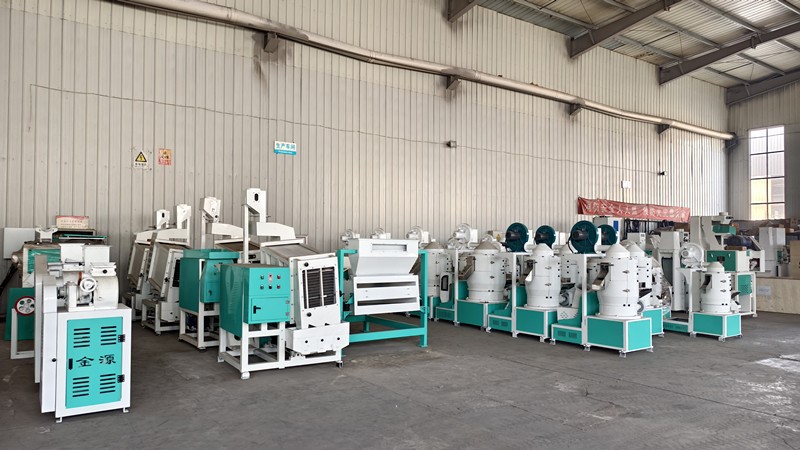
Our Factory
Yutai Jinyuan Machinery Co., Ltd. is a professional manufacturer of grain processing equipment with a 30-year history. The company has a registered capital of 10 million yuan and total assets of over 30 million yuan. It covers an area of 50000 square meters and employs more than 50 people. The company mainly produces rice milling machinery, and its products cover the entire process of rice initial processing from rice cleaning, stone removal, hulling, separation to rice whitening, polishing, and color selection. There are a total of 7 series and more than 130 varieties. The company has a comprehensive product development system and modern production capacity, as well as industry-leading professional process equipment and product research and development centers. The company has participated in the construction of large-scale complete rice milling projects both domestically and internationally, ranking among the top in comprehensive market share.


Production Equipment



FAQ
As one of the leading paddy separator manufacturers and suppliers in China, we warmly welcome you to buy durable paddy separator made in China here and get quotation from our factory. All customized machines are with high quality and competitive price.