


Model Series: RP-500 to RP-3000
Processing Capacity: 2-12 metric tons/hour
Power Requirements: 7.5-30 kW (3-phase 380V)
Polishing Efficiency: 98.2-99.3%
Broken Rice Rate:...
Rice Polishing Machine
Why Choose Us?
Advanced equipment
The company mainly produces rice milling machinery, and its products cover the entire process of rice initial processing from rice cleaning, stone removal, hulling, separation to rice whitening, polishing, and color selection. There are a total of 7 series and more than 130 varieties. The company has a comprehensive product development system and modern production capacity, as well as industry-leading professional process equipment and product research and development centers.
Rich experience
Yutai Jinyuan Machinery Co., Ltd. is a professional manufacturer of grain processing equipment with a 30-year history. The company has a registered capital of 10 million yuan and total assets of over 30 million yuan.
Professional team
Our company has a professional design team with many years of market experience, which has participated in the design, installation, commissioning, and service of multiple complete projects. The company has a professional installation team of more than 20 people, who can organize or allocate installation personnel at any time to improve customer progress and ensure project schedule.
High quality
For each complete set of projects, especially large-scale engineering projects, a project team will be established to design, order, purchase, produce, distribute, transport, deliver, install, debug, and supervise quality, coordinate work progress, and project team members are both independent and cooperative, enabling the entire project to proceed smoothly.
What Is Rice Polishing Machine
The rice polishing machine can be effectively useful for removing floating bran on the rice surface. It will also play a major role in gelatinization and pre-gelatinization of the rice surface. The starch gelatinization can make up for cracks.
With that, you can obtain a clean and bright appearance and enhance the commercial value of rice and storage performance. It consists of a polishing part, sprays water part, air spraying mechanism, water supply system, discharging device and feeding device.
-
![Milled Rice Polishing Machine]()
-
![Rice Spray Polishing Machine]() Rice Spray Polishing MachineOur rice spray polishing machine is a reliable, heavy‑duty solution built for continuous rice milling operations. It uses a fine water spray system to gently polish rice grains, remove surface...read more
Rice Spray Polishing MachineOur rice spray polishing machine is a reliable, heavy‑duty solution built for continuous rice milling operations. It uses a fine water spray system to gently polish rice grains, remove surface...read more -
![Rice Brightening Machine]() Rice Brightening MachineThe rice brightening machine is a state-of-the-art processing equipment designed to enhance the appearance, quality, and market value of rice through gentle yet effective polishing and...read more
Rice Brightening MachineThe rice brightening machine is a state-of-the-art processing equipment designed to enhance the appearance, quality, and market value of rice through gentle yet effective polishing and...read more -
![Horizontal Rice Polishing Machine]() Horizontal Rice Polishing MachineThe fully automatic rice processing equipment, with its unique one click start and fully automatic operation mode, not only greatly saves labor costs, but its outstanding performance and excellent...read more
Horizontal Rice Polishing MachineThe fully automatic rice processing equipment, with its unique one click start and fully automatic operation mode, not only greatly saves labor costs, but its outstanding performance and excellent...read more -
![Double Roll Rice Polishing Machine]() Double Roll Rice Polishing MachineLarge and medium-sized enterprises have great flexibility in their production processes, enabling them to process different types of raw materials and different amounts of raw materials. The...read more
Double Roll Rice Polishing MachineLarge and medium-sized enterprises have great flexibility in their production processes, enabling them to process different types of raw materials and different amounts of raw materials. The...read more -
![Curved Rice Polishing Machine]() Curved Rice Polishing MachineThe curved rice polishing machine is a cutting-edge equipment designed to refine rice quality by removing impurities, bran residues, and surface dust, delivering glossy, clean grains that meet...read more
Curved Rice Polishing MachineThe curved rice polishing machine is a cutting-edge equipment designed to refine rice quality by removing impurities, bran residues, and surface dust, delivering glossy, clean grains that meet...read more


Advantages of Rice Polishing Machine
The rice polishing machine enhances the commercial value and grade of the rice. The colloidal layer can extend the shelf life and enhance the antioxidant capacity of rice.
The smooth, crystal clear and clean rice surface can get no panning. It ensures that the taste is delicious and soft, and rice loses fewer nutrients. The taste is delicious and soft, and that can enhance the rice's edible quality.
It can be effectively useful in conjunction with the rice milling unit and for deep rice processing. It has a high-cost performance compact structure and is best for grain enterprises. The equipment is perfect in appearance, generous and simple, and a better assistant for small and medium-sized Rice Mill business.
This machine is effectively useful for polishing white rice through the rice milling process to enhance the smoothness and precision of white rice.
It is the best part of the equipment to produce high-quality polished rice. Stable operation, reasonable technology, convenient maintenance and simple operation highlight this rice polishing machine.
How to Add Water to the Rice Polishing Machine
The operating procedures are as follows:
Start-Up Procedure
Ensure that the rice polishing machine, fan, and water landing parts are functioning normally.
1.Turn on the power supply.
2.Start the fan.
3.Start the polishing machine.
4.Once the polishing machine is running normally, gradually turn on the flow control panel. Adjust the rice output pressure door on the flow control board according to the output, quality, and current of the rice output.
Watering
1.Adjust the water temperature and volume as needed. The polishing room has two water supply points: the cage and the hollow spindle. The hollow spindle should be filled with water more quickly, while the water reaction in the cage is slower. When increasing the water amount through the cage, do so gradually to avoid excessive water and potential blockage.
2.Increase the water amount if rice or chaff is accompanied by rice flour or small pieces of rice skin, and if there are noticeable rice grooves on the surface. Under normal conditions, if the rice forms small clusters when twisted, the water amount is likely appropriate. At this stage, the rice surface should be smooth and shiny. If the water amount is too high, only a few rice flakes will cluster together.
Shutdown Procedure
1.Stop the water flow.
2.Stop feeding rice.
3.Turn off the polishing machine once the rice in the polishing room is emptied.
4.Allow the polishing machine and fan to continue running for 5 minutes before stopping the fan. This ensures the polishing room dries to reduce residue and prevent water accumulation.
Disconnect the power supply.
Working Process of Rice Polishing Machine
The white rice milled by the rice mill to the standard one-meter accuracy flows down from the feed port into the polishing room, and at the same time, the heated water (used when the room temperature is lower than 15°C) is passed through the flow meter through the rubber tube through the temperature-controlled water tank. The air-water mixing nozzle forms water mist through high-pressure air and enters the hollow main shaft impingement area.
Under the action of strong negative pressure suction, the water mist passes through the main shaft and the vent holes of the polishing roller and enters the surface of the polishing roller to mix with rice and adhere to it. On the surface of the rice grain, the surface of the rice grain is moistened and softened. Through the rotating movement of the polishing roller in the polishing chamber, the rice grains are continuously moved in the polishing chamber.
During the movement, relative movement, relative friction and squeezing occur between the rice grains, between the rice grains and the polishing roller, and between the rice grains and the rice sieve. Because the surface of the rice grains is wet and soft, this friction will remove the bran powder and acne on the surface of the rice grains on the one hand. On the other hand, the starch layer on the surface of white rice undergoes gelatinization and crystallization during the friction extrusion process to form a bright protective film, which improves the surface finish and prolongs the storage time of the later rice. The fine rice bran and fine chips produced during the polishing process are removed from the machine through the rice sieve under the action of negative pressure and strong suction.

The Function of Rice Polishing Machine
After careful whitening, the rice already has its typical white colour. However, the rice bran still adheres to the grain, the surface is slightly rough and the grain does not shine yet.
The rice is conveyed by the feed screw into the working chamber. Here, a rotor with cams in combination with the friction between the grains and between the grains and the screen basket ensures that the rice is gently polished. The removed bran is sucked off through a screen basket, which surrounds the working chamber, and leaves the machine via an aspirated separate outlet.
The intensity of the polishing process can be variably adjusted by means of the outlet plate loaded with counterweights. Furthermore, water or other liquids can be added during the polishing process. This makes it possible to produce a nice shiny grain.
Air cools the product during the polishing process and at the same time supports the discharge of adhering whitening bran. The rice polishing machine is available in two sizes, thus covering a wide capacity range.
Advantages of the rice polishing machine:
● Gentle treatment
● Uniform load
● Dust-free operation
Depending on the intensity of the whitening machines, there is a large quantity of whitening bran on the surface of the grain. It is also possible to use several consecutive rice polishing machines depending on the desired end product quality. In the subsequent process, the rice is sorted into different quality levels by means of a plansifter and an indented cylinder.
Types of Rice Polishing Machine
Vertical cone polisher: This machine uses a covered cone within a perforated screen to create an abrasive surface for polishing rice.
Horizontal polisher: This machine uses a cylinder covered in emery that is placed within another cylinder and rotated to polish the rice.

Why Polish Rice Grains: Rice Polishing Machine
Polishing of rice grains is done primarily for aesthetic and practical reasons, not for health benefits. Unpolished or brown rice is indeed more nutritious than polished white rice, as it retains more of the bran and germ layers which are removed during the polishing process.
The main reasons rice is polished include:
● Appearance: Polished white rice has a more uniform, appealing appearance preferred by many consumers. The brown bran layer of unpolished rice can be seen as less visually appealing.
● Shelf life: Polishing removes the oil-rich bran and germ, which can cause the rice to go rancid more quickly. Polished white rice has a longer shelf life.
● Texture and cooking properties: Polished rice has a softer, more delicate texture that some prefer. The bran in brown rice can make it chewier and harder to cook evenly.
● Cultural preferences: In many cultures, polished white rice is the traditional and preferred form, seen as more refined and desirable.
While unpolished brown rice is indeed more nutritious, retaining vitamins, minerals, and fiber, polished white rice remains the more common commercial product due to consumer demand and practical considerations around appearance, shelf life, and cooking properties.
Types of Rice Polishing Machines: Abrasive vs. Friction Polishers
Before rice reaches our plates, it undergoes several processing steps. Polishing is a crucial step in this process as it enhances the rice's appearance, improves its nutritional content, and extends its shelf life. Two popular types of rice polishing machines are abrasive and friction polishers, each playing a significant role in this process.
Abrasive Rice Polishing Machines
Mechanism: Abrasive rice polishing machines use a combination of friction and abrasion to remove the outer layers of the rice grains. The friction, caused by the abrasive surface—typically made of emery or silicon carbide—removes the bran and germ layers from the rice kernels. This process results in a smoother and more translucent appearance, commonly associated with polished rice.
Advantages:
High Polishing Efficiency: Abrasive polishers are highly effective, capable of achieving a high degree of polish in a short amount of time.
Consistent Quality: They provide consistent polishing, ensuring uniformity in the rice’s appearance and texture.
Reduced Breakage: Abrasive polishers generally cause less breakage of rice grains compared to friction polishers.
Applications: Abrasive rice polishing machines are widely used in large-scale rice mills where efficiency and uniformity are crucial. They are particularly favored for processing long-grain rice varieties such as Basmati and Jasmine, where maintaining aesthetic appeal is essential.
Friction Rice Polishing Machines
Mechanism: Friction rice polishing machines operate on a different principle. Instead of using abrasives, they rely on frictional forces to remove the outer layers of rice grains. The rice kernels pass through a rotating chamber with a rough surface, generating heat and friction. This process loosens and detaches the outer layers from the kernel.
Advantages:
Lower Heat Generation: Friction polishers generate less heat during the polishing process compared to abrasive polishers, which helps preserve the rice’s nutritional content.
Gentle on Fragile Grains: They are well-suited for polishing delicate rice varieties that are prone to breakage, such as short-grain or glutinous rice.
Energy Efficiency: Friction polishers are generally more energy-efficient, making them a sustainable choice for some rice processing facilities.
Applications: Friction rice polishing machines are ideal for processing specialty rice varieties, such as short-grain or sticky rice. They are also preferred in facilities that prioritize energy conservation and the preservation of the rice's nutritional value.
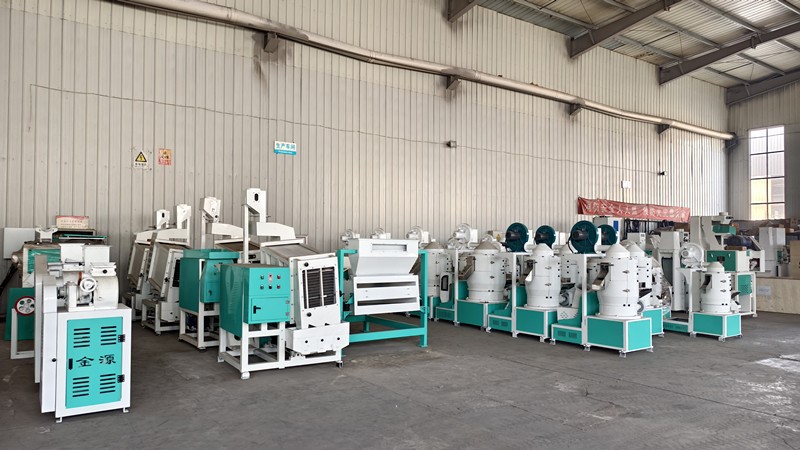
Our Factory
Yutai Jinyuan Machinery Co., Ltd. is a professional manufacturer of grain processing equipment with a 30-year history. The company has a registered capital of 10 million yuan and total assets of over 30 million yuan. It covers an area of 50000 square meters and employs more than 50 people. The company mainly produces rice milling machinery, and its products cover the entire process of rice initial processing from rice cleaning, stone removal, hulling, separation to rice whitening, polishing, and color selection. There are a total of 7 series and more than 130 varieties. The company has a comprehensive product development system and modern production capacity, as well as industry-leading professional process equipment and product research and development centers. The company has participated in the construction of large-scale complete rice milling projects both domestically and internationally, ranking among the top in comprehensive market share.


Production Equipment



FAQ
As one of the leading rice polishing machine manufacturers and suppliers in China, we warmly welcome you to buy durable rice polishing machine made in China here and get quotation from our factory. All customized machines are with high quality and competitive price.
rice polishing machine for food importers, rice polishing machine with stable performance, rice polishing machine for the profitability of rice businesses