

Vertical Rice Mill
Why Choose Us?
Advanced equipment
The company mainly produces rice milling machinery, and its products cover the entire process of rice initial processing from rice cleaning, stone removal, hulling, separation to rice whitening, polishing, and color selection. There are a total of 7 series and more than 130 varieties. The company has a comprehensive product development system and modern production capacity, as well as industry-leading professional process equipment and product research and development centers.
Rich experience
Yutai Jinyuan Machinery Co., Ltd. is a professional manufacturer of grain processing equipment with a 30-year history. The company has a registered capital of 10 million yuan and total assets of over 30 million yuan.
Professional team
Our company has a professional design team with many years of market experience, which has participated in the design, installation, commissioning, and service of multiple complete projects. The company has a professional installation team of more than 20 people, who can organize or allocate installation personnel at any time to improve customer progress and ensure project schedule.
High quality
For each complete set of projects, especially large-scale engineering projects, a project team will be established to design, order, purchase, produce, distribute, transport, deliver, install, debug, and supervise quality, coordinate work progress, and project team members are both independent and cooperative, enabling the entire project to proceed smoothly.
What Is Vertical Rice Mill
There are two kinds of rice mills, the vertical type and the horizontal type which are commonly used in the rice milling industry. The vertical-type rice mill roller is a cone-shaped mortar without the ribs and grooves on its surface, which can be forward or reverse.
-
![Vertical Sand Roller Rice Mill]() Vertical Sand Roller Rice MillThe characteristics of vertical sand roller rice miller The vertical sand roller rice miller is to place two grinding rollers in a vertical position, the grinding surface direction is vertical to...read more
Vertical Sand Roller Rice MillThe characteristics of vertical sand roller rice miller The vertical sand roller rice miller is to place two grinding rollers in a vertical position, the grinding surface direction is vertical to...read more -
![Vertical Iron Roller Rice Mill]() Vertical Iron Roller Rice MillOur vertical iron roller rice mill is a high-efficiency grain processing equipment engineered for large and medium rice milling plants, integrating advanced design and practical performance. It is...read more
Vertical Iron Roller Rice MillOur vertical iron roller rice mill is a high-efficiency grain processing equipment engineered for large and medium rice milling plants, integrating advanced design and practical performance. It is...read more


Rice Milling Process of Vertical Rice Mill
It is very important that you know what milling is all about before you start the process cycle. The total time required to produce rice includes two things, one is the initial setup time and the other is the cycle time for each part.
The setup time of a vertical rice mill includes the time required to make its operation, plan all the tool movements and install the fixtures in the vertical rice mill. The cycle time, however, is depended on four things:
● The load and unload time
This is the time required to load the workpiece into the machine and then secure it with the fixture. It also includes the time to unload the finished part. The load time is different in different vertical rice mills depending on the size, weight, complexity of the workpiece and the type of fixture.
● The cut time
It is the amount of time taken to make all the necessary cuts with the help of the cutter in the workpiece for each operation. In order to calculate the cut time for any operation, you have to divide the total cut length for the operation with the feed rate. This gives the operation speed of the cutter relative to the workpiece.
● The ideal time
It is also defined as the non-productive time in a milling operation. This is the time when neither the workpiece nor the cutter is engaged in the milling process. This includes all those processes like the tool approaching and retracting from the workpiece, tool movements between features, the time required for adjustment of the machine settings and the changing tools.
● The tool replacement time
This is the amount of time required to replace a tool that has exceeded its time of operation and has worn out effectively.
This time isn't included in all the operation and is taken into consideration when the tool has reached its lifetime. This time has to be adjusted in the entire milling process.
What Is the Goal of Vertical Rice Mill
A commercial vertical rice mill will have following objectives:
● Produce edible rice that appeals to the customer - i.e. Rice that is sufficiently milled and free of husks, stones, and other non-grain materials
● Maximize the total milled rice recovery out of paddy and minimize grain breakage
The Vertical Rice Mill Working Process
1. Pre-cleaning the paddy prior to milling
2. Removing the husk or outer layer from the paddy
3. Rice milling section
4. Polishing or whiting the brown rice to remove the bran layer
5. Separating the broken grains from the whole kernels
6. Color sorting
7. Bagging the milled rice
8. Managing the by-products,mainly for fuel of steam boiler or stove.


The rice mill industry offers a plethora of opportunities for entrepreneurs looking to enter the agricultural sector. With the growing demand for rice and the potential for export markets, venturing into this business can be highly profitable.
One of the key opportunities in the rice mill industry is vertical integration. By establishing strong relationships with farmers, you can ensure a consistent supply of high-quality paddy. This not only helps in maintaining quality control but also enables you to negotiate better prices and reduce dependency on external suppliers.
Another opportunity lies in diversification. Apart from producing milled rice, consider adding value-added products such as parboiled rice or branded specialty varieties to your product line. These niche market segments often command higher prices and have a loyal customer base seeking unique flavors or healthier options.
Furthermore, technological advancements present immense possibilities in streamlining operations and increasing efficiency. Investing in modern machinery like automated sorting systems or precision grading equipment can greatly enhance productivity while reducing labor costs.
There are opportunities to establish partnerships with government agencies or NGOs working towards improving food security and promoting sustainable agriculture practices. Collaborating on projects related to seed development, organic farming techniques, or research initiatives can not only boost your credibility but also open doors to funding opportunities.
Rice Mill Machine: Paddy Rice Huller and Husk Separator
Rice milling is one of the post-harvest handling technology that is quite popular in agriculture (rice farmers). This machine has helped many farmers in terms of processing paddy to rice. In the aspect of business, these machines are also able to increase the marketability of agricultural products as opposed to selling in the form of paddy directly. On the other hand, demand for rice continues to increase, because the rice has been a staple food for most countries in the world. Hence the development of rice mill machine is more effective, more efficient and more quality is promising.
In the processing of un-hulled rice, in order to produce high-quality rice, we have to use some machines like paddy rice huller machine, husk separator, rice polisher and rice sifter.
1. Paddy rice huller machine is used to break and release bran (husk). Input materials of this machine is a un-hulled rice with a moisture content of about 14% and output in the form of brown rice (pure white).
2. Husk separator is used to separate grain of rice and husk using a blower system. The system utilizes the difference in specific gravity between rice and husk. Husk which has a smaller specific gravity to be sucked by the blower, while rice tend not to be affected by the air blower and straight out through the rice outlet.
3. Rice polisher is used to remove the epidermis (aleuron) on brown rice to produce white rice that is ready to be marketed or cooked. This machine uses the screw extruder system in the cylinder which has the inner surface uneven. When brown rice fed into the cylinder it will jostle and rub against the cylinder surface which causes the epidermis to be eroded.
4. Rice shifter is used to separate the rice based group quality such as whole rice (best quality) and broken rice (second quality). This machine uses a filter screen plate or cylinder shaped. Rice with some sort of quality level will be mixed again with a certain ratio to determine the selling price before the rice is packaged to be marketed.
This article will explain in more detail on the description of the machine, but it is limited to brown rice huller and separator machine. Both machines will be combined into one machine as the title of this article, namely Rice Mill Machine: Paddy Rice Huller and Husk Separator. Description of these machines include machine construction, main part of machine, basic concept of brown rice huller and separator, machine principle and machine operation.
The Difference Between Vertical and Horizontal Rice Mills
A vertical rice mill is primarily used to process rice directly into white rice. It automatically separates the rice, fine bran, small broken rice, and rice husks without requiring additional windmills or separators. The raw grain processed by this machine has high purity. Coarse bran is automatically returned to the mill, while the bran rice is separated and converted into fine bran, which can be used as high-quality feed.
The vertical rice mill is popular due to its strong functionality, wide applicability, and efficiency. It is equipped with an iron screen in the working chamber, and a grinding wheel is installed within the screen to create a gap for peeling the raw grain. During operation, the screen and grinding wheel rotate in opposite directions, effectively removing the seed coat from the grains. Simultaneously, air separation helps to separate the kernel from the seed coat, significantly reducing breakage and improving peeling quality and yield.
Understanding the Vertical Rice Mill
The function of a vertical rice mill must be understood before exploring the optimization advantages. With the use of this sophisticated equipment, rice grains may have their bran layers removed, producing polished, refined rice that is fit for human consumption.
Enhanced efficiency in the milling workflow
Machines for vertical rice whitening are designed to be efficient. Their design makes it possible for a more efficient milling procedure, which shortens the time needed to turn raw paddy into polished rice. By facilitating a continuous flow and reducing interruptions, the vertical structure maximizes overall operating efficiency.
Consistent quality output
The uniformity that vertical rice whitening adds to the end product's quality is one of its main benefits. The equipment makes sure that rice grains are polished and whitened uniformly, which minimizes differences in texture and appearance. Maintaining this consistency is essential to satisfying the high expectations that markets and customers have set.
Minimized grain breakage
The integrity of rice grains is the primary consideration in the design of vertical rice whitening technology. These devices increase milling yields by reducing grain breakage during the whitening process. This is a particularly important factor for rice millers that want to maximize output without sacrificing grain quality.
Adaptable to different rice varieties
Because of its adaptability, vertical rice whitening machines can handle different kinds of rice. The technique is flexible enough to enable rice millers to meet a wide range of market needs without sacrificing productivity or quality, regardless of the kind of rice — long-grain, short-grain, or basmati.
Reduced energy consumption
Energy-saving features are included in several contemporary vertical rice mills. This lowers operating expenses for rice millers while still being in line with environmental standards. The integration of cutting-edge technology guarantees the best possible outcomes with the least amount of energy used.
Easy maintenance and operation
One benefit of incorporating vertical rice whitening into milling operations is that it is easier to operate and maintain. Rice millers may minimize downtime and guarantee equipment longevity with easily accessible components and straightforward controls.
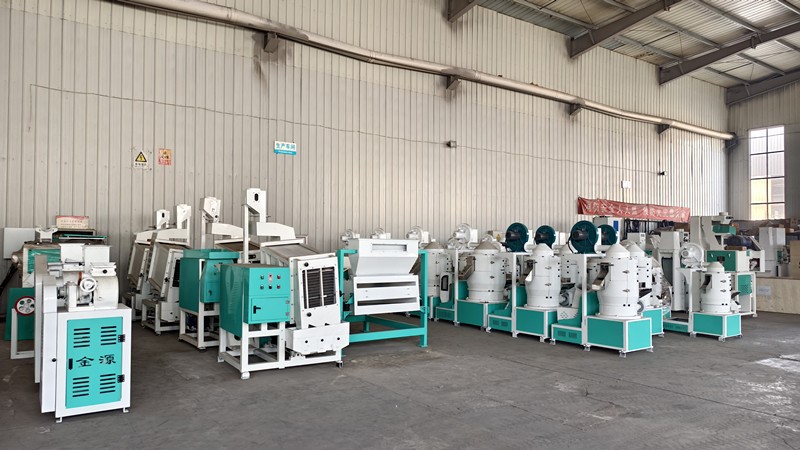
Our Factory
Yutai Jinyuan Machinery Co., Ltd. is a professional manufacturer of grain processing equipment with a 30-year history. The company has a registered capital of 10 million yuan and total assets of over 30 million yuan. It covers an area of 50000 square meters and employs more than 50 people. The company mainly produces rice milling machinery, and its products cover the entire process of rice initial processing from rice cleaning, stone removal, hulling, separation to rice whitening, polishing, and color selection. There are a total of 7 series and more than 130 varieties. The company has a comprehensive product development system and modern production capacity, as well as industry-leading professional process equipment and product research and development centers. The company has participated in the construction of large-scale complete rice milling projects both domestically and internationally, ranking among the top in comprehensive market share.


Production Equipment



FAQ
As one of the leading vertical rice mill manufacturers and suppliers in China, we warmly welcome you to buy durable vertical rice mill made in China here and get quotation from our factory. All customized machines are with high quality and competitive price.
vertical iron roller rice mill, vertical sand roller rice mill, vertical rice mill