


Model Series: RP-500 to RP-3000
Processing Capacity: 2-12 metric tons/hour
Power Requirements: 7.5-30 kW (3-phase 380V)
Polishing Efficiency: 98.2-99.3%
Broken Rice Rate:...
Rice Processing Equipment
Why Choose Us?
Advanced equipment
The company mainly produces rice milling machinery, and its products cover the entire process of rice initial processing from rice cleaning, stone removal, hulling, separation to rice whitening, polishing, and color selection. There are a total of 7 series and more than 130 varieties. The company has a comprehensive product development system and modern production capacity, as well as industry-leading professional process equipment and product research and development centers.
Rich experience
Yutai Jinyuan Machinery Co., Ltd. is a professional manufacturer of grain processing equipment with a 30-year history. The company has a registered capital of 10 million yuan and total assets of over 30 million yuan.
Professional team
Our company has a professional design team with many years of market experience, which has participated in the design, installation, commissioning, and service of multiple complete projects. The company has a professional installation team of more than 20 people, who can organize or allocate installation personnel at any time to improve customer progress and ensure project schedule.
High quality
For each complete set of projects, especially large-scale engineering projects, a project team will be established to design, order, purchase, produce, distribute, transport, deliver, install, debug, and supervise quality, coordinate work progress, and project team members are both independent and cooperative, enabling the entire project to proceed smoothly.
What Are the Products of Rice Processing Equipment
- Rice Processor
- Rice Separator Machine
- Rice Color Selection Machine
- Rice Destoning Machine
- Rice Milling Equipment
- Broken Rice Separator
- Rice Milling Machine
- Rice Polisher
-
![Milled Rice Polishing Machine]()
-
![Corn Peeling Machine]() Corn Peeling MachineModel range: CP-300 to CP-1200 seriesread more
Corn Peeling MachineModel range: CP-300 to CP-1200 seriesread more
Throughput capacity: 2-12 MT/hour
Power requirement: 5.5-15 kW (3-phase)
Peeling efficiency: 98.5-99.2%
Kernel damage rate:... -
![NZJ Type Millet Processing Equipment]() NZJ Type Millet Processing EquipmentThe NZJ type millet processing equipment is specialized equipment for food processing and rice processing. It is controlled via a mobile phone interface and includes a destoner, cleaning machine,...read more
NZJ Type Millet Processing EquipmentThe NZJ type millet processing equipment is specialized equipment for food processing and rice processing. It is controlled via a mobile phone interface and includes a destoner, cleaning machine,...read more -
![Rice Polishing Machine]() Rice Polishing MachineThe new rice polishing machine is a device used for polishing the surface of rice grainsread more
Rice Polishing MachineThe new rice polishing machine is a device used for polishing the surface of rice grainsread more -
![Rice Cleaning and Sorting Machine]() Rice Cleaning and Sorting MachineOur clean sieve machine is a must-have for rice processing work, built to take out all kinds of impurities from paddy and rice like stones, dust, broken grains and mildewed rice, while sorting...read more
Rice Cleaning and Sorting MachineOur clean sieve machine is a must-have for rice processing work, built to take out all kinds of impurities from paddy and rice like stones, dust, broken grains and mildewed rice, while sorting...read more -
![Bucket Lifting Processing Machinery]() Bucket Lifting Processing MachineryThe bucket lifting processing machinery is a complete integrated grain processing system that combines bucket elevator lifting, cleaning, peeling, milling, polishing and sorting functions....read more
Bucket Lifting Processing MachineryThe bucket lifting processing machinery is a complete integrated grain processing system that combines bucket elevator lifting, cleaning, peeling, milling, polishing and sorting functions....read more -
![Small Processing Equipment]() Small Processing EquipmentOur small processing equipment series combines space-saving design with the performance of large, professional equipment. If you operate a small to medium-sized grain processing plant and need...read more
Small Processing EquipmentOur small processing equipment series combines space-saving design with the performance of large, professional equipment. If you operate a small to medium-sized grain processing plant and need...read more -
![Millet Processing Peeling Machine]() Millet Processing Peeling MachineThe principle of Millet peeling machine mainly includes several steps such as soaking, lifting, peeling, screening, and air selection. read more
Millet Processing Peeling MachineThe principle of Millet peeling machine mainly includes several steps such as soaking, lifting, peeling, screening, and air selection. read more -
![Millet Processing Equipment]() Millet Processing EquipmentThe main characteristics of millet processing equipment include production capacity, footprint, price, functionality, and failure rate.read more
Millet Processing EquipmentThe main characteristics of millet processing equipment include production capacity, footprint, price, functionality, and failure rate.read more -
![25 Ton Fresh Rice Milling Equipment]() 25 Ton Fresh Rice Milling EquipmentThis complete 25 ton fresh rice milling equipment utilizes fully automatic technology and uses high-quality rice varieties. The unique features of our industrial-grade machinery include a robust...read more
25 Ton Fresh Rice Milling EquipmentThis complete 25 ton fresh rice milling equipment utilizes fully automatic technology and uses high-quality rice varieties. The unique features of our industrial-grade machinery include a robust...read more -
![Fully Automatic New Durable Elevator]() Fully Automatic New Durable ElevatorDesigned specifically for high-volume rice processing lines, our fully automatic new durable elevator stands as a robust, high-efficiency conveying solution engineered to streamline the transfer...read more
Fully Automatic New Durable ElevatorDesigned specifically for high-volume rice processing lines, our fully automatic new durable elevator stands as a robust, high-efficiency conveying solution engineered to streamline the transfer...read more -
![Grain Crop Production And Processing]() Grain Crop Production And ProcessingOur fully automatic rice processing equipment is a cutting - edge solution engineered to revolutionize grain crop production and processing workflows. Designed for high - efficiency and precision,...read more
Grain Crop Production And ProcessingOur fully automatic rice processing equipment is a cutting - edge solution engineered to revolutionize grain crop production and processing workflows. Designed for high - efficiency and precision,...read more


What Is Rice Color Selection Machine
The rice color selection machine uses photoelectric technology to automatically sort out the different-colored particles in the rice according to the difference in the optical characteristics of the rice, so as to achieve the effect of improving the quality of the rice and removing impurities.
Color Sorters and Rice Whitener Machines Used in Rice Mill
Now, we'll explain about different color sorters and rice whiter machines used in rice mill:
1. Rice color sorter
The rice color sorter machine separates rice grains according to the colors of raw rice.
2. Rice whitener machine
The equipment whitens brown rice by adopting advanced techniques. The machine has useful functions to give whitening to rice grains.
3. Grain dryer machine
It is a piece of special equipment for the drying process in a rice factory. It removes moisture and water from rice grains and dries them up. Thus, the grain dryer machine makes rice protected for storage and makes rice fit for hulling. The hot air blower fixed inside the machine helps get the desired degree of drying.
Before Using the Rice Color Selection Machine
Check for any foreign substances in the hopper and remove them if present.
Turn on the air compressor and wait until the pressure gauge indicates 0.6 MPa or above (the maximum air pressure should be 0.8 MPa during the initial test).
Inspect the air passage for any leaks. Any leakage can be addressed by tightening the adapter at the leakage point. Note that slight airflow at the ejector is normal. Additionally, check that the waste liquid in the air filter has been automatically drained.
Check for any impurities on the vibrator trays, channels, or the glass of the observation cabinet. If impurities are found, clean them with an air gun or cloth, but avoid using hard materials for cleaning. Note: It is prohibited to wipe the channels with hard materials, as this can damage the surface of the channels and impair the sorting effect.
Confirm that the power supply pins are properly plugged in.

What Is a Rice Separator Machine
The paddy table is an assembly of indented plates mounted on a single vibrating frame. The trays are inclined in two directions, lengthways and widthways. It separates a mixture of paddy and brown rice into three distinct classes.
There Are Two Types of Paddy Separators
Compartment Separator: The compartment type of paddy separator uses differences in specific gravity and buoyancy to separate paddy and brown rice. When paddy and brown rice move over an inclined plane, they move at different speeds depending on their specific gravity, shape, contact area, smoothness of the inclined surface, and the coefficient of sliding friction. Brown grains are smaller, heavier, rounder, and smoother and will slide faster than paddy grains. The processing capacity of the compartment separator depends on the compartment area. For a 2-ton/hr capacity rice mill, a 45-compartment separator with 15 compartments on each of three decks is used.
Tray Separator: The tray separator uses differences in specific gravity, grain length, and the coefficient of friction to separate paddy and brown rice. The oscillation and slope of the tray force the brown rice to move up the slope and the paddy to slide down. The separation performance of this type of paddy separator is very good. This machine is very compact, easy to adjust, and consumes less power than the compartment type separator.

Rice Separator Machine Working Principle
Rice separator machine machine is used to separate the brown rice from the paddy that is not be husked, it workds according to the difference of specific gravity, granularity and friction coefficient between paddy and brown rice, through the special separating tray to screen the mixture continuously, making it in stratification state.
Due to the function of separation, big-density and small-size brown rice towards to the upper of the separating tray, small specific gravity and large-size paddy towards to the lower part of the separating tray, then separating pure brown rice, mixture and pure paddy.
What Is Rice Destoning Machine
A rice destoner is a machine which removes stones, sand, clods from grains, such as rice, paddy, beans,etc. To make the grains free from stones. It's also called rice destoning machine, a rice destoner machine is one of the integral machines in the whole rice processing line.
Why Using a Rice Destoning Machine
The threshed grain will normally contain a mix of some stones, sand, small pebbles, plant and insect waste, seed cases, etc. These impurities lower the quality of the crops and it may also cause a focal point for potential infestation during storage.
Conventionally, the simplest cleaning method is called winnowing. This is usually done by tossing the grain into the air and letting the wind take off the lightest impurities. Although winnowing is widespread in farming, this cleaning method can't eliminate the heavier impurities such as stone, gravel, etc. Also, the method is labor-intensive.
But using the machine, small and large impurities can be separated from your grain more effectively, allowing you to have a hitch-free operation on your farm.
How Does the Rice Destoning Machine Work
The rice destoning machine is an essential piece of equipment in rice processing plants. It is primarily used to remove stones and other impurities mixed with the rice to reduce the sand content and ensure the quality of the rice. A thorough understanding of the working principle and operation of the destoning machine is crucial for improving its performance.
The main working mechanism of the destoning machine involves the destoner screen. After the material enters the destoner screen, the difference in suspension speed between stones and rice causes the lighter rice to float to the top layer, while the heavier stones sink due to their greater suspension speed. This process creates a natural separation, with the rice in the upper layer and the stones in the lower layer. The airflow further enhances this separation by increasing the gaps between the materials and reducing the pressure and friction between the layers, promoting better classification.
The rice in the upper layer, which has a lower suspension speed, is moved by gravity, inertia, and air flow. The stones and heavier debris in the lower layer are separated from the rice and slide along the sieve surface towards the stone outlet. As the upper layer material falls, high-speed stones and debris are gradually separated and move into the lower layer. The lighter rice remains in a semi-suspended state, continuously moving upward. When the material reaches the end of the stone screen, the remaining rice contains very few stones. This rice is then blown back into the main rice stream by the airflow, while the stones are continuously removed and exit through the stone outlet.
The Main Factors Affecting the Normal Operation of a Rice Destoning Machine
For a rice destoning machine to operate normally, the upstream airflow through the material layer must match the suspension speed of the rice. If the air velocity is too high, the material may be blown through the screen. Conversely, if the airflow speed is too low, the rice may not be adequately suspended and could mix with the stones, leading to an increased stone content in the rice. Poor material classification can result in stones being present in the rice, which reduces separation efficiency.
Inclination Angle: The inclination angle is the angle between the stone removal screen surface and the horizontal plane. The size of this angle affects both the yield and efficiency of the destoning machine, often in contradictory ways. A larger inclination angle increases the flow rate of the rice but reduces the efficiency of stone removal. A smaller inclination angle decreases the flow rate and can lead to a higher stone content in the rice, resulting in more stones being left in the grain. Typically, the inclination angle of a stone removal machine ranges from 5 to 9 degrees.
Throw Angle: The throw angle refers to the angle and direction of the vibration of the sieve body. The vibrating sieve operates with a reciprocating linear motion, with the vibration direction tilted relative to the axis of the vertical vibration motor. This angle affects how stones move along the screen surface. Proper adjustment of the throw angle aids in the automatic classification of materials and the separation of stones. However, if the throw angle is too large, the material may jump out of the screen, which hinders effective separation. Generally, the throw angle of the stone removal machine is between 30 and 35 degrees.
Amplitude and Vibration Frequency: Amplitude refers to the extent of vibration of the sieve. Larger amplitude and higher frequency increase the speed at which material moves across the screen and enhance the automatic classification function, which improves separation efficiency and equipment yield. However, excessive amplitude or frequency can cause violent vibrations that may disrupt material classification and reduce efficiency. Conversely, too little amplitude or frequency slows down the material movement, thickens the material layer, and hampers automatic classification, thus affecting both separation efficiency and machine output. Typically, the amplitude of the stone removal machine is about 3.5 to 5 mm. The vibration motor’s frequency is usually not adjusted; for eccentric rotation machines, the frequency is directly related to the speed.
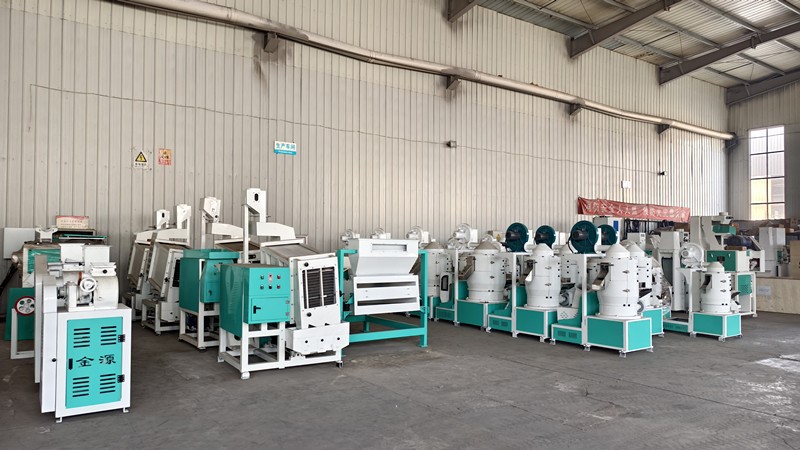
Our Factory
Yutai Jinyuan Machinery Co., Ltd. is a professional manufacturer of grain processing equipment with a 30-year history. The company has a registered capital of 10 million yuan and total assets of over 30 million yuan. It covers an area of 50000 square meters and employs more than 50 people. The company mainly produces rice milling machinery, and its products cover the entire process of rice initial processing from rice cleaning, stone removal, hulling, separation to rice whitening, polishing, and color selection. There are a total of 7 series and more than 130 varieties. The company has a comprehensive product development system and modern production capacity, as well as industry-leading professional process equipment and product research and development centers. The company has participated in the construction of large-scale complete rice milling projects both domestically and internationally, ranking among the top in comprehensive market share.


Production Equipment



FAQ
As one of the leading rice processing equipment manufacturers and suppliers in China, we warmly welcome you to buy durable rice processing equipment made in China here and get quotation from our factory. All customized machines are with high quality and competitive price.
rice processing for catering services, search for rice processing equipment, rice processing to meet food safety standards