

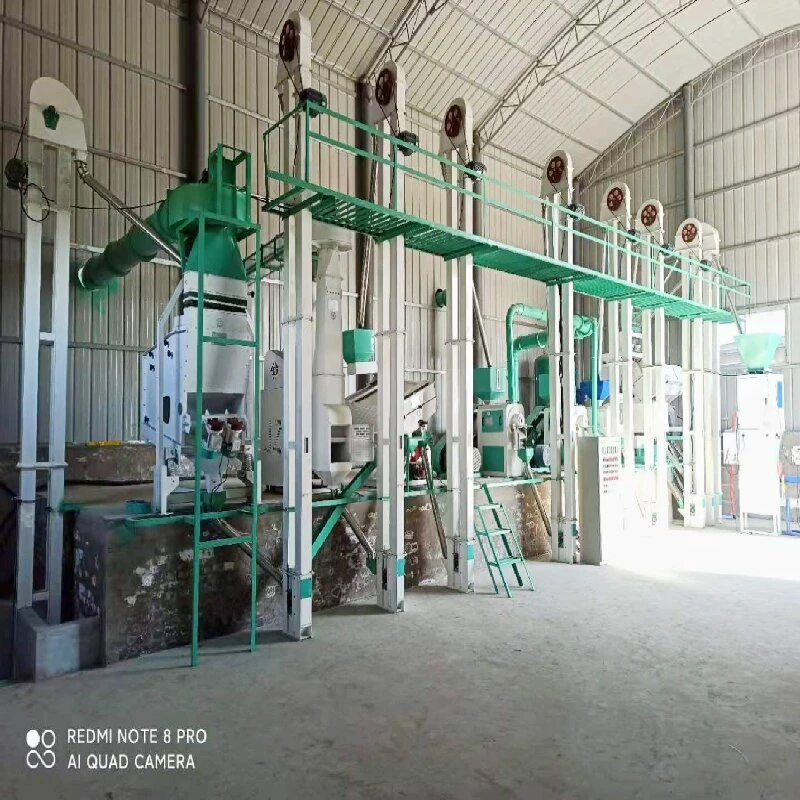
Products Description
Shandong Yutai Jinyuan Machinery Co., Ltd. manufactures rice husking machines, which are used for rice dehulling. The machine works mainly through the relative movement of a pair of rubber rollers with different rotational speeds. The rice is extruded and torn under a certain pressure to achieve dehulling. Then, by utilizing the difference in suspension speed between rice and rice husks, the rice mixture is separated from the husks through air suction. During the shelling process, some grains may be cracked or incomplete. Due to the pressure between the rollers, some grains may also be crushed and broken.

The moisture content of brown rice before entering the rice mill can also affect the rate of broken rice. When the water content is low, the pressure required for whitening increases, inevitably leading to a higher amount of broken rice. Excessive moisture, loose rice texture, and decreased strength can also increase the amount of broken rice. In practice, broken rice can be reduced through tempering. The conditioning of brown rice mainly involves wetting and roughening it, which softens the cortex, reduces the binding force between the cortex and endosperm, and lowers the temperature of the brown rice (usually below room temperature). This process reduces the pressure inside the rice milling chamber, thereby minimizing the amount of broken rice produced during the milling process.
Rice milling is the process of using a sand roller and an iron roller to mill rice grains, peeling off the outer layer of brown rice to achieve the goal of producing white rice. Although brown rice is more nutritious than white rice, the cellulose content in the outer layer of brown rice is much higher than that in the endosperm, and cooking it directly does not yield a pleasant taste. Therefore, brown rice is generally not used for direct cooking. Rice milling primarily utilizes the frictional force generated by the relative motion between the rice grains, between the rice grains and the milling rollers, and between the rice grains and the rice sieve, as well as the cutting effect of dense sand blades on the surface of brown rice, to effectively remove the outer layer and smooth the surface of the brown rice.

After several rounds of rice milling, the rice temperature will rise significantly above room temperature. Entering the back polishing section without cooling will inevitably cause the rice to burst, increase the amount of broken rice, and affect the quality of the finished product. Cooling the rice prevents it from bursting due to drastic changes in temperature and humidity, and reduces the amount of broken rice. Additionally, after cooling, the rice temperature during polishing will not be too high, which is more suitable for starch gelatinization on the surface of the rice, forming a bright, colloidal film.
Hot Tags: 20 tons combined rice mill, China 20 tons combined rice mill manufacturers, suppliers, factory, medium rice mill operational information, medium rice mill commissioning information, benefits of medium rice mill, medium rice mill vs other rice mills information, medium rice mill spare parts information, medium rice mill data analysis


